Our comparison uses published, named rankings (Top100GolfCourses, GOLF Magazine) and cross-checks them with our open data on 686 golf courses. We publish no player reviews and no ratings of our own. Our method.
The ranking of the best courses in France, golf terms, the length of a course and five quizzes to test yourself. And to play: 686 golf courses across the 13 regions, from French Ministry of Sports and OpenStreetMap open data.
We do not make our own ranking. Here is the one published by Top100GolfCourses, a British site that ranks courses country by country, as we consulted it on 1 October 2026:
Le Golf National, Albatros course (Yvelines): Île-de-France
This ranking covers courses, not clubs: Les Bordes appears twice. The ten courses therefore belong to nine golf clubs.
A second ranking confirms the top of the list. GOLF Magazine places Morfontaine 38th in the world in its 2025-2026 edition. Top100GolfCourses ranks it 45th in the world and first in continental Europe.
Several of these clubs are private. Morfontaine only welcomes guests invited by one of its 450 members. Before you travel, check with the club that green fees are open to visitors.
Sources: Top100GolfCourses, France ranking and Morfontaine page, consulted on 1 October 2026 (the ranking shows no edition date); GOLF Magazine, Top 100 Courses in the World 2025-2026, Morfontaine page.
Our reviews are based on spec sheets and on buyer ratings published by retailers, never on a rating of our own.
Best putter 2026: the top 5 for your level (video in French)
Five putters from five brands, ranked from buyer ratings at Decathlon and Amazon France, collected on 1 October 2026. We did not have them in hand: the video explains the ranking rule, then how to choose for your stroke.
In France, people say "un parcours" or, more often, "un golf". The Rules of Golf call it the course: the whole playing area inside the boundaries set by the club. The course has five areas:
the teeing area, where each hole starts;
the general area, which covers the fairway and the rough;
penalty areas, such as lakes and streams;
bunkers, hollows filled with sand;
the putting green, where the hole is.
A full course has 18 holes. Many golf clubs also have a 9-hole course. The name changes with the terrain:
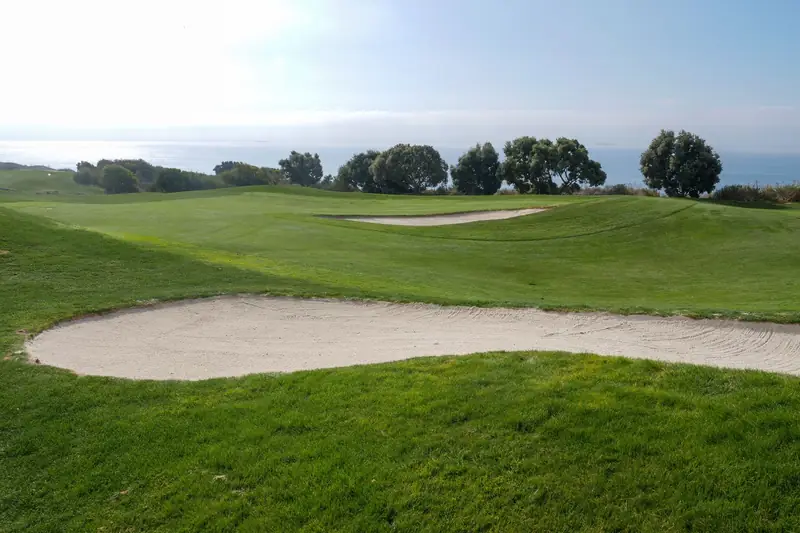
Links: a seaside course, laid out on dunes. The Old Course at St Andrews is the example most often cited.
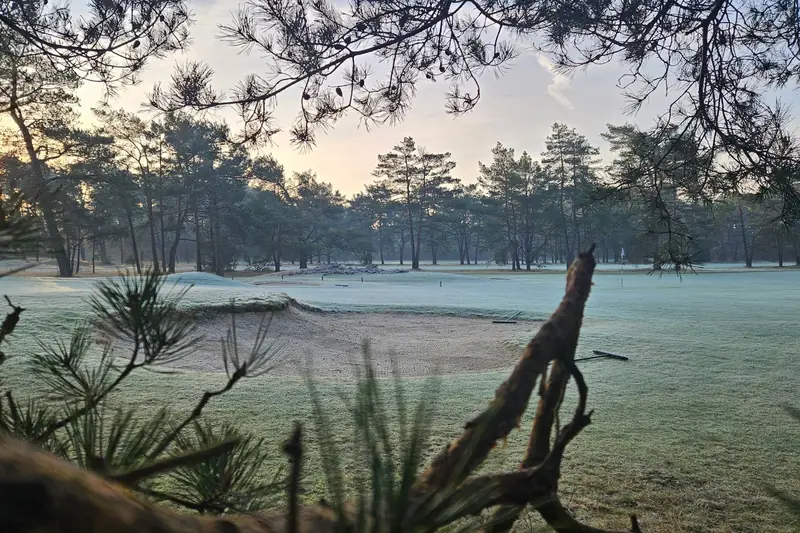
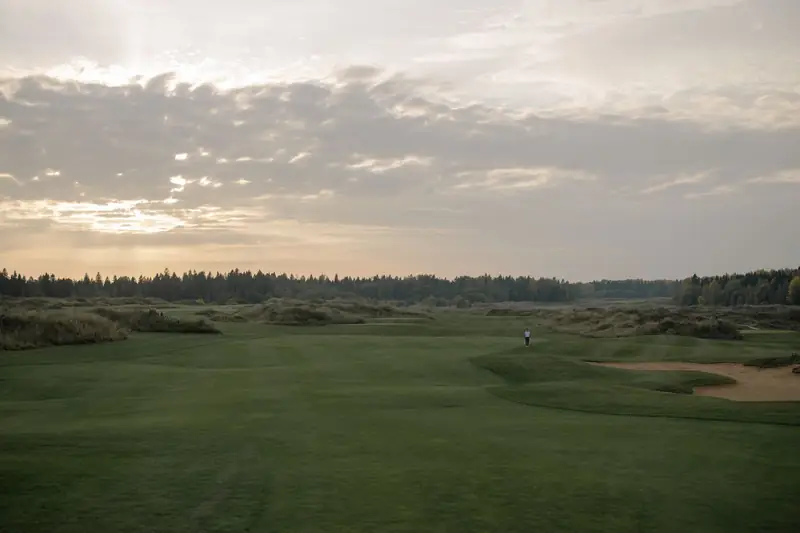
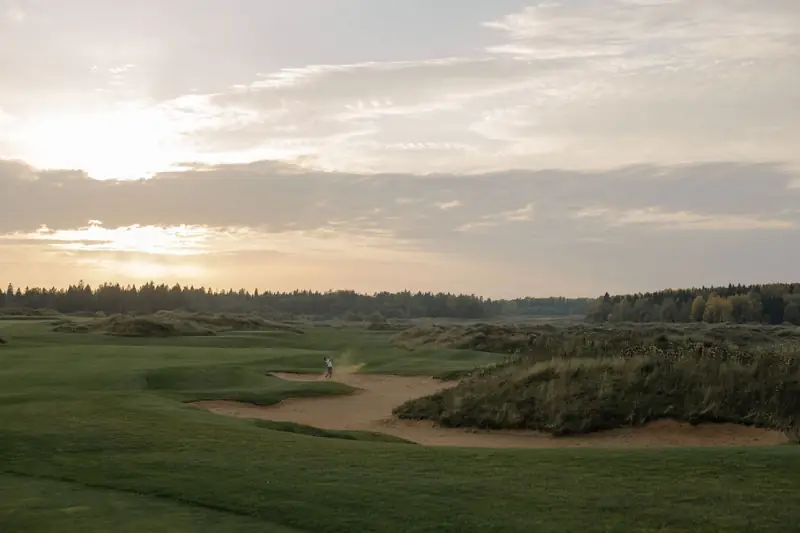
Heathland course: sand, heather and pines. Morfontaine, in the Oise, belongs to this family.
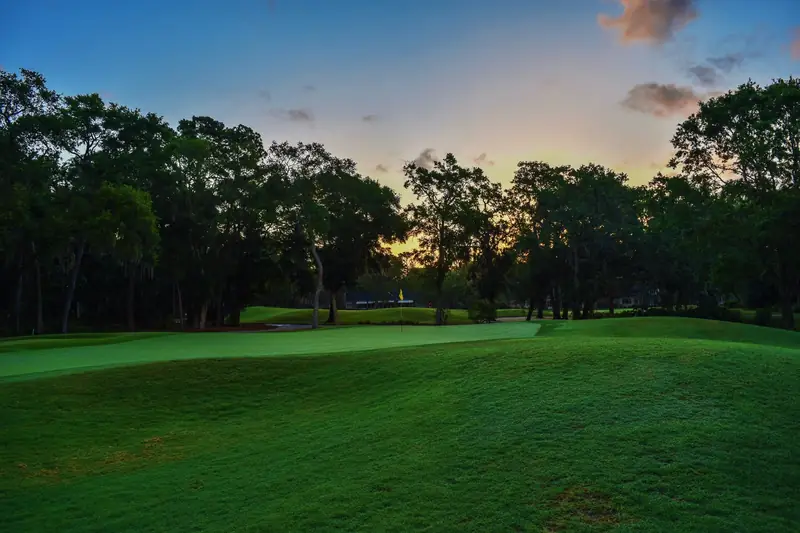
Parkland course: lawns and tall trees, the most common type in France.
Compact course and pitch & putt: short courses, for beginners or a quick round.
In French, "club" means both the association that runs the golf course and the stick that hits the ball. The club-house is the reception building.
Sources: Rules of Golf, R&A and USGA, 2023 edition, definition of the course; Top100GolfCourses, Morfontaine page, consulted on 1 October 2026.
Here are the words you will hear from your first round. When the French word differs, we give it in brackets: you will see it on scorecards and club notices.
Par: the number of strokes set for a hole or for the whole course.
Birdie: one stroke under par. Eagle: two strokes under. Albatross (albatros): three strokes under.
Bogey: one stroke over par. Double bogey: two strokes over.
Tee: the small peg you put the ball on to start a hole. By extension, the starting area itself (départ).
Fairway: the strip of mown grass that runs from the tee to the green.
Rough: the long grass along the fairway.
Bunker: a hollow hazard filled with sand.
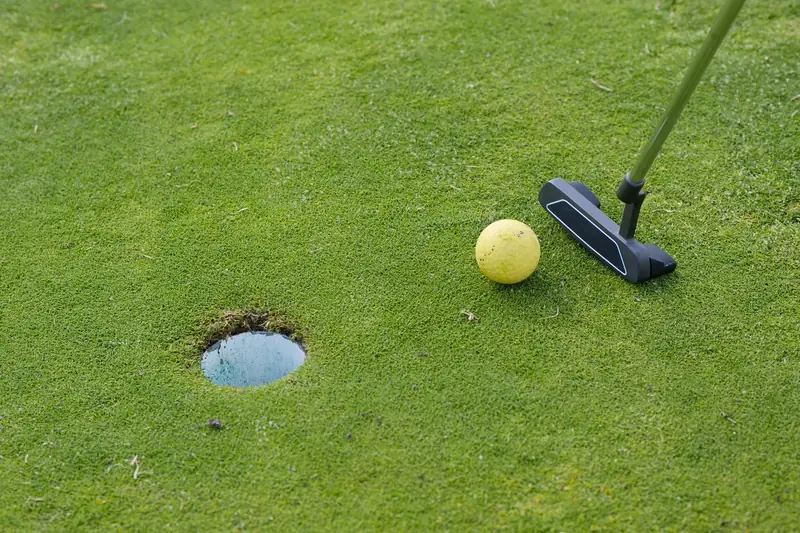
Green: the closely mown grass around the hole, where you use your putter.
Handicap index (index): your playing level as a number. In France, a new player starts at 54 and brings it down in competitions.
Slope: how hard a course is for an average player, from 55 to 155. The standard value is 113.
Putt: the stroke played on the green to roll the ball into the hole. Approach (approche): a short shot played towards the green.
Driving range (practice): the practice area, with mats and targets. In a French club, "le practice" always means the range.
Compact course (compact): a short course, mostly par 3s, for learning.
Sources: French Golf Federation (ffgolf), "Le terrain de jeu" and "Comment ça marche, les classements au golf" (8 May 2026), consulted on 1 October 2026; Wikipedia, "Vocabulaire du golf" and "Slope rating", consulted on 1 October 2026.
An 18-hole course measures about 6 km and takes about 4 hours to play. A 9-hole course measures about 2.5 km. These are the figures given by the French Golf Federation.
Most 18-hole courses have a par of 70 to 72. The par of a hole depends on its length. The World Handicap System guidelines, for men:
par 3: up to 240 m;
par 4: 220 to 450 m;
par 5: 410 to 650 m.
For women, a par 3 goes up to 200 m and a par 5 from 340 to 550 m.
French courses give distances in metres: 100 m is about 109 yards.
The length also depends on the tee you play from. The French federation recommends a tee based on the length of your drive: white beyond 200 m, yellow from 180 to 200 m, blue from 160 to 180 m, red from 140 to 160 m, orange from 120 to 140 m, purple below that.
Two real examples: Morfontaine measures 6,001 m for a par of 70. The Old Course at St Andrews measures 7,305 yards, about 6,680 m, for a par of 72.
Short courses: a 9-hole compact course takes about 2 hours, with mostly par 3s. A pitch & putt has only par 3s of 90 m at most.
Sources: French Golf Federation, "Le terrain de jeu", consulted on 1 October 2026; National Club Golfer, World Handicap System par guidelines, 9 October 2024; Le Grand Club, ffgolf tee recommendations, 31 March 2025; Top100GolfCourses and Wikipedia, consulted on 1 October 2026.
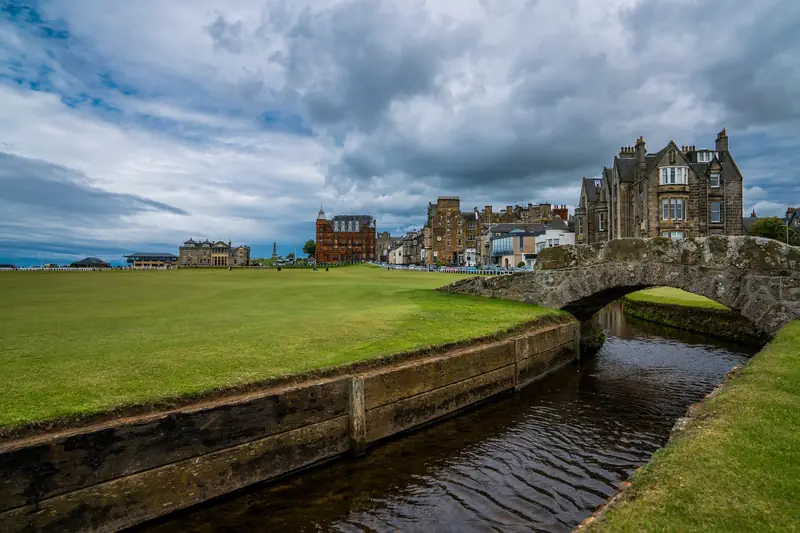
The Old Course at St Andrews, in Scotland. Golf has been played there since the early 15th century, and it is known as the oldest golf course in the world.
1552: the Archbishop of St Andrews grants local people the right to play on these links.
1754: the society of golfers that will become the R&A is founded. The R&A writes the Rules outside the United States and Mexico.
1764: the course moves to 18 holes, the format that became the standard everywhere.
30 Opens played there, a record. The last one was in 2022.
The small stone Swilcan Bridge crosses the burn of the same name, between the 1st and 18th fairways. The course belongs to the public, under the care of a trust: visitors book their tee time.
In France, four golf clubs carry a comparable history:
Pau Golf Club: opened in 1856 according to Data ES, the oldest in our database. The club presents itself as the first course in continental Europe.
Chantilly: founded in 1909, it hosted 11 French Opens between 1913 and 1990.
Morfontaine: a polo ground turned golf course in 1913, redesigned by Tom Simpson in the late 1920s.
Le Golf National: the 2018 Ryder Cup, the first played in France, won by Europe 17.5 to 10.5, then the 2024 Olympic tournament.
Sources: Wikipedia, "Old Course at St Andrews" and "Golf de Chantilly", consulted on 1 October 2026; Data ES, French Ministry of Sports, extract of 1 October 2026; Pau Golf Club, club website, consulted on 1 October 2026; Top100GolfCourses, Morfontaine page; Le Golf National, Ryder Cup 2018 page, consulted on 1 October 2026.
10 questions, with the explanation for each answer. Open "See the answer" after each one.
In stroke play, who plays first on the next tee?
The player with the lowest handicap in the group
The player who hit the longest drive
The player with the lowest score on the previous hole
The oldest player in the group
See the answer
Answer C. This is called the honour: the best score on the previous hole tees off first (Rule 6.4). In a friendly round, "ready golf" is encouraged to save time.
Away from the tee, which player plays first?
The one whose ball is farthest from the hole
The one whose ball is nearest to the hole
The one who played first from the tee
The one with the lowest handicap in the group
See the answer
Answer A. The ball farthest from the hole is played first (Rule 6.4). In stroke play, playing out of turn carries no penalty.
How long do the Rules recommend you take to play a stroke, once it is your turn?
20 seconds at most
60 seconds at most
90 seconds at most
40 seconds at most
See the answer
Answer D. Rule 5.6 recommends playing in 40 seconds at most, and usually less. Prepare your shot while the others play.
Your ball stops on the green of another hole. What do you do?
I play it as it lies, changing nothing
I take free relief, as I must
I take relief with a one-stroke penalty
I putt it to avoid damaging the green
See the answer
Answer B. Playing from a wrong green is not allowed: relief is required and free (Rule 13.1f). It protects the green for other players.
After rain, your ball is embedded in its own pitch mark on the fairway.
I play it as it lies
I take relief without penalty
I take relief with a one-stroke penalty
I declare it unplayable
See the answer
Answer B. A ball embedded in the general area gives you free relief (Rule 16.3).
Your ball lies in a temporary puddle on the fairway.
I take relief with a one-stroke penalty
I replay from where I last played
I take relief without penalty
I play it as it lies
See the answer
Answer C. A temporary puddle is "temporary water": you can take free relief (Rule 16.1). It is not a penalty area.
While searching for your ball in the rough, you move it with your foot by accident.
No penalty, I replace it
One penalty stroke, I replace it
Two penalty strokes, I play it
No penalty, I play it from there
See the answer
Answer A. Since 2019, moving your ball by accident during a search costs nothing. You replace it on its original spot (Rule 7.4).
Your ball enters a penalty area marked with red stakes. What option does a red area add to a yellow one?
Free relief at the nearest point
Placing the ball back on the fairway
A new shot from the tee, without penalty
Lateral relief within two club-lengths
See the answer
Answer D. Both areas let you replay from your previous spot or drop back on the line from the flagstick. A red area adds lateral relief within two club-lengths, with one penalty stroke (Rule 17.1).
Your ball bounces and hits your own bag by accident.
No penalty, I play it as it lies
One penalty stroke, I play it as it lies
Two penalty strokes, I replay the shot
No penalty, but I replay the shot
See the answer
Answer A. Since 2019, a ball that hits the player or their equipment by accident carries no penalty (Rule 11.1).
In Stableford scoring, how many points is a par worth?
1 point
2 points
3 points
0 points
See the answer
Answer B. In Stableford, a bogey is worth 1 point, a par 2 points, a birdie 3 points (Rule 21.1).
10 questions, with the explanation for each answer. Open "See the answer" after each one.
What do you call a hole played one stroke under par?
An eagle
A bogey
An albatross
A birdie
See the answer
Answer D. Birdie: one under par. Eagle: two under. Albatross: three under. Bogey: one over.
You play a par 5 in 3 strokes. What is your score on this hole?
An eagle
A birdie
An albatross
A par
See the answer
Answer A. 3 strokes on a par 5 is two under par: an eagle.
How many strokes under par is an albatross?
Two strokes
One stroke
Three strokes
Four strokes
See the answer
Answer C. The albatross, three under par, mostly happens on a par 5 played in 2 strokes. It is one of the rarest scores in golf.
You play a par 4 in 6 strokes. What is this score called?
A bogey
A double bogey
A triple bogey
A par
See the answer
Answer B. 6 strokes on a par 4 is two over par: a double bogey.
What is the fairway?
The long grass that borders the hole
The closely mown surface around the hole
The practice area of the golf club
The mown strip between the tee and the green
See the answer
Answer D. The fairway links the tee to the green. The long grass along it is the rough, the short surface around the hole is the green.
What is a divot?
A mark left by the ball on the green
A sandy hollow next to the fairway
A piece of turf cut out by the club
A small peg to rest the ball on
See the answer
Answer C. A divot is the piece of turf taken out by an iron shot. You replace it or fill the hole with the sand provided. A ball mark on the green is repaired with a pitch-mark repairer.
What does the slope of a course measure?
Its difficulty for an average player
Its average gradient from tee to green
Its total length from the white tees
The number of bunkers on the course
See the answer
Answer A. Slope compares how hard the course is for an average player and for a scratch player, with a handicap of 0. It runs from 55 to 155; 113 is a standard difficulty.
In France, what handicap index does a new player get in competition?
36
54
28
45
See the answer
Answer B. The first index is 54, given after a first ranking competition. It then drops with your results (ffgolf, 8 May 2026).
What is a "hole in one"?
A hole played one stroke under par
A course where every hole is a par 3
A ball holed with the tee shot
A putt holed from the edge of the green
See the answer
Answer C. A hole in one almost always happens on a par 3. On a par 3, it is also an eagle.
In a French golf club, what does the word "practice" mean?
The first hole of the main course
The reception building for players
The round played before a competition
The driving range, with mats and targets
See the answer
Answer D. The practice is where you warm up and work on your shots: the driving range. The reception building is the club-house.
Coming soon. This form will open once partner golf courses have agreed to receive requests. Their list will appear here before anything is sent. Today, no data is collected.